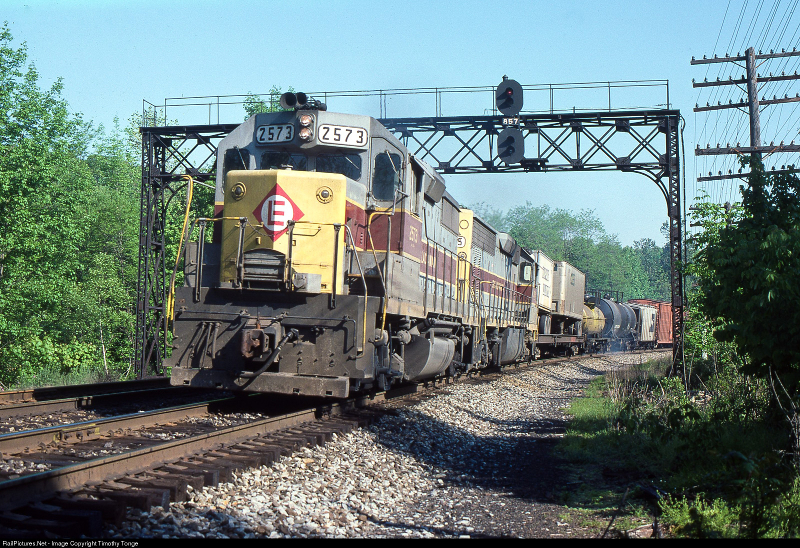
The Erie Lackawanna
was formed in 1960 through the merger of the Erie and Delaware, Lackawanna,
and Western railroads. It's tracks extended from the New Jersey bank of
the Hudson River to Chicago by way of Binghamton, Hornell, Meadville, and Marion.
The merger was a logical one, since the two railroads had been sharing the DL&W
passenger terminal in Hoboken for several years, and their main lines in the
Southern Tier of New York were essentially parallel. Unfortunately, the
economic climate of the late 1960s and early 1970s, combined with substantial
damages from Hurricane Agnes in 1972, drove the railroad into backruptcy in
1972. The trustees were unable to pull the railroad out of bankruptcy,
and it was incorporated into Conrail on April 1, 1976. The former DL&W
mainline between the Delaware Water Gap and Scranton was split between Lackawanna
County and Conrail, with the eastern portion going to Conrail. The Delaware-Lackawanna
Railroad currently uses the western portion to serve several new customers,
and Steamtown runs excursions from Scranton to Moscow. The mainline from
Scranton to Binghamton was sold to the Delware and Hudson. This line is
in use today, linking the D&H/CP's Taylor Yard with Binghamton.
With apologies to purists, the prototype locations described below and in linked
pages are only those I've included in the model railroad (except for Gouldsboro).
The Scranton Division of the Erie Lackawanna extended from Delaware River west and (compass) northwest through Scranton to West BD interlocking in Binghamton. It also included the Bloomsburg, Utica, Syracuse, Wyoming, and Bangor & Portland branches. Operations were based in Scranton, with the division's business offices and Dispatcher located in the passenger station downtown.
Located in the Pocono Mountains of southeastern Pennsylvania, Scranton was once the heart of Anthracite Country, the primary source of the hard coal. A clean-burning fuel, Anthracite was a popular fuel for heating in the early 20th century and generated a lot of railroad traffic, primarily from the mines along the branches in the Lackawanna Valley. At it's height the Delaware, Lackawanna, and Western operated five yards in the Scranton area to handle local freight, classify general freight, handle eastbound and westbound coal loads, and marshall empties for the mines. In addition to the coal traffic, the DL&W's main locomotive shops were located at Scranton. It was quite a busy location -- and that was just the DL&W; other railroads in town included the Delaware and Hudson, Central RR of NJ, and the Erie!
Unfortunately Anthracite's popularity didn't last, and dwindling demand combined with the Knox Mine disaster in 1956, which flooded many of the deep mines in the Lackawanna valley, cost the area much of that activity. To make matters worse for the Scranton Division, the DL&W merged with the Erie Railroad in 1960, and the combined road had two routes from the NY metropolitan area to Binghamton, New York. In the early years of the merger, much of the remaining freight traffic was routed over the former Erie's Delaware Division. The Scranton Division still had a few trains, including the passenger trains, but the majority of the traffic went through Port Jervis. With the end of passenger trains in 1970, traffic on the division was sparse.
During the late 1960s
and early 1970s the financial climate in the northeast worsened and many of
the railroads suffered. The Erie Lackawanna was surviving, but cash was
very tight, and the damage caused by flooding from Hurricane Agnes forced the
road to file for bankruptcy. After the bankruptcy filing in 1972, the
railroad began instituting even more extensive cost-cutting measures than had
been in place previously. One such measure was to downgrade the Delaware
Division, remove one of the tracks and the signals, and reroute traffic to the
Scranton Division. By 1975 most of the traffic moved over the Scranton
Division, with 11 symbol and 6 mainfest freights scheduled daily. Extras,
Helper operations, and Bloomsburg Branch trains nearly doubled the traffic in
the area.
Scranton Division
Stations
Summarized from the 1974 Scranton
Division Employee Timetable
| |
|
|
| |
|
|
| |
|
|
| |
|
|
| |
|
|
| |
|
|
| |
|
|
| |
|
|
| |
|
|
| |
|
|
| |
|
|
| |
|
|
| |
|
|
| |
|
|
| |
|
|
| |
|
|
| |
|
|
| |
|
|
| |
|
|
| |
|
|
| |
|
|
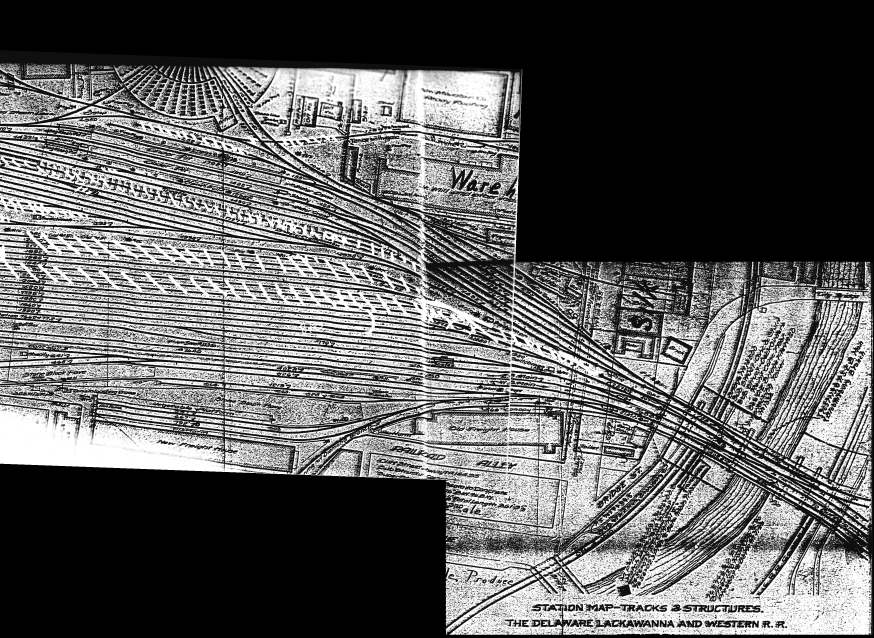
Plan of the western portion of Scranton yards, from the 1918 Interstate Commerce Commission (ICC) Valuation Map (click on image for larger version):
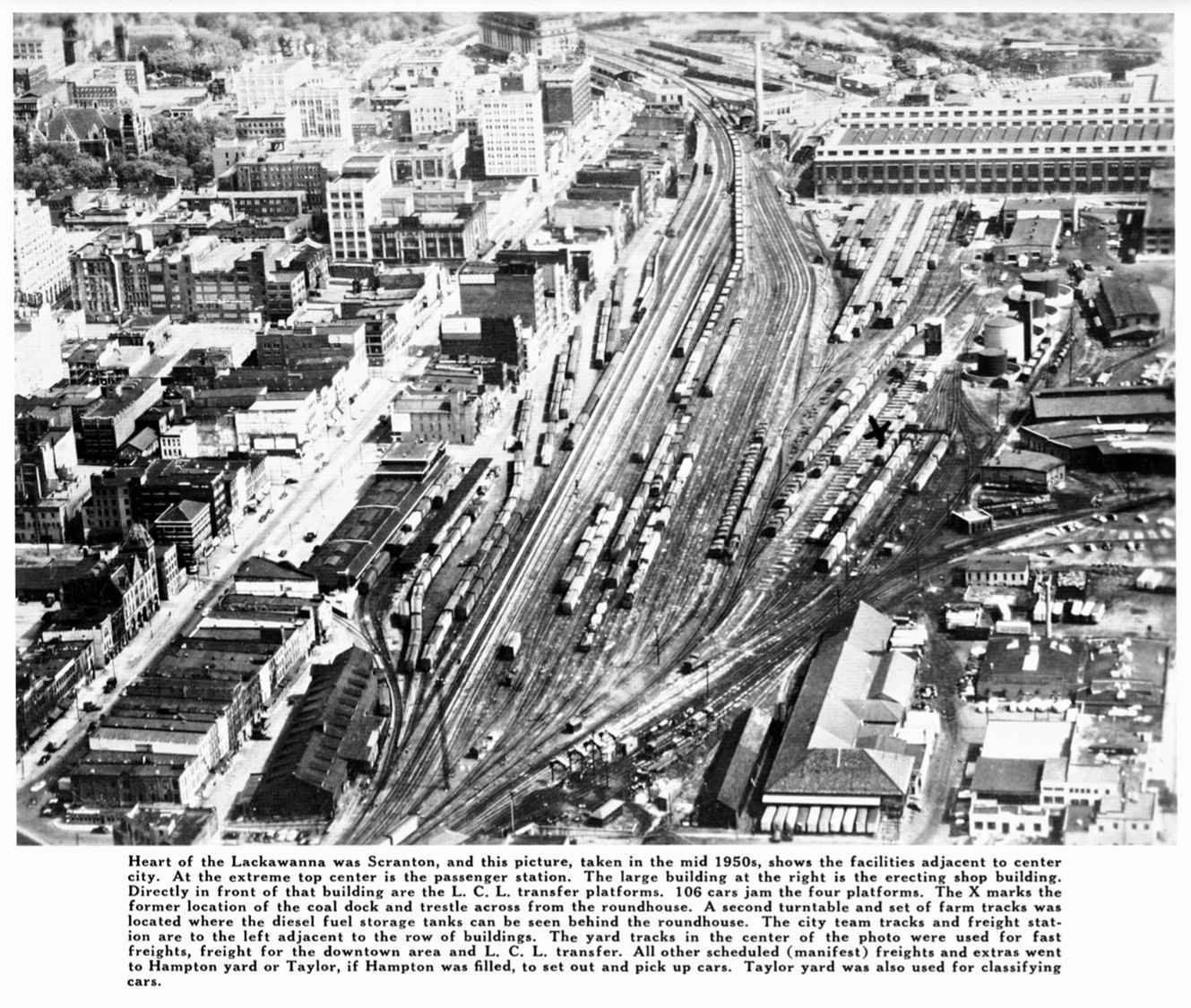
1950s aerial photo of downtown Scranton from Tom Tabor's definitive history (see Information Source) of the DL&W (click on image for larger version):
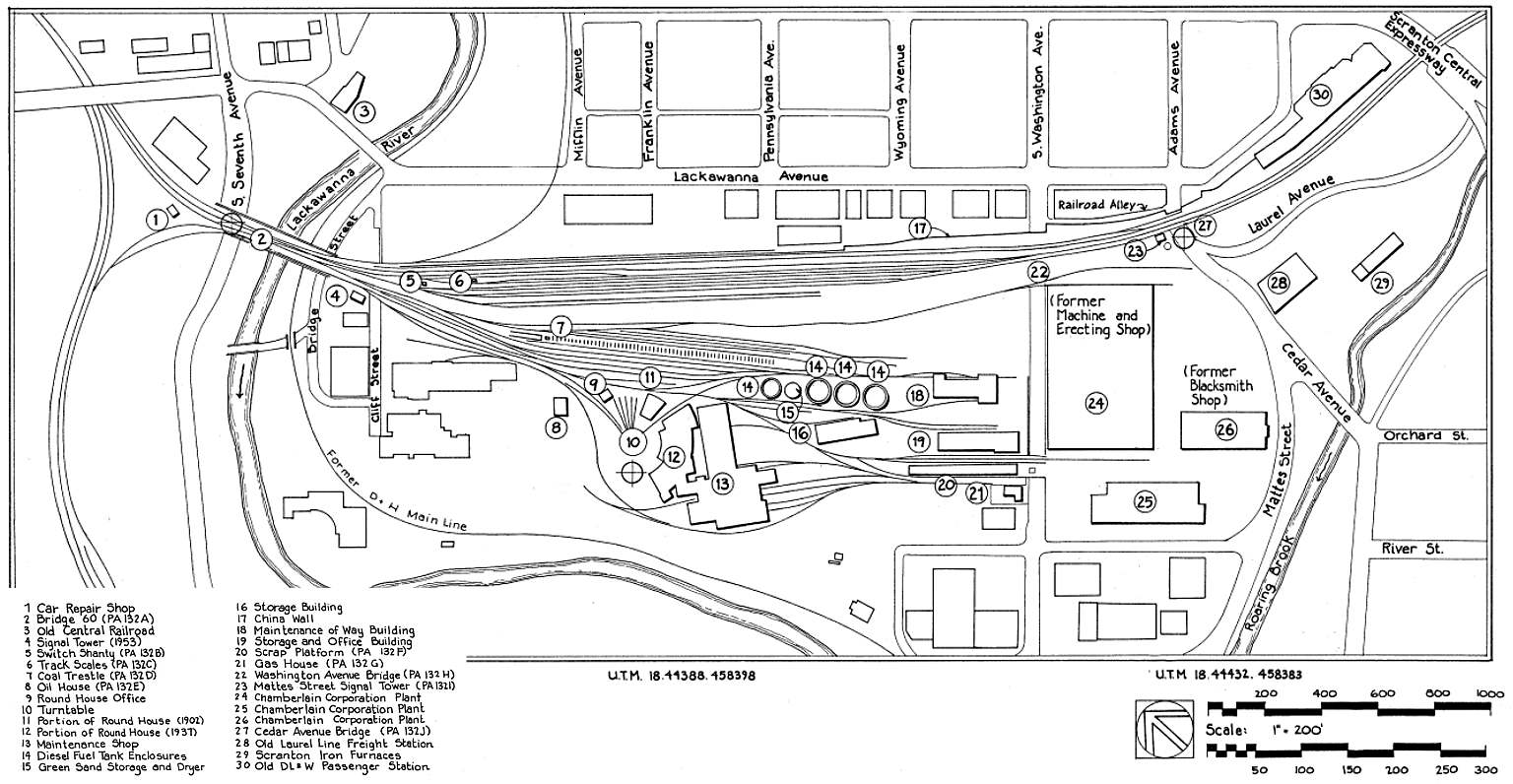
Plan of Scranton prepared by the National Park Service at the start of Steamtown (click on image for larger version):
George
Elwood's Incredible EL Site
Check out the model version